An agent beside you
What you have: the modeler, running, with teapot.stl open — case 1's
own starting point. What you want: an agent, working beside you in the
same window, doing case 1's own five edits over MCP — while you keep your
own hands on the document too, and neither of you can undo the other's work
by accident.
This is screen 26, "Agent session": the tool-call feed, a history list with "You"/"Agent" badges, undo restricted to the agent's own steps, and a six-view contact sheet under the viewport. No new fixture geometry — case 6 is entirely about how the work gets in, not what it is.
1. Start the agent's door
Launch the modeler with an MCP port open:
cd apps/flutter3d_modeler
          FLUTTER3D_WINDOW=1440x900 flutter run -d macos --dart-define=mcpPort=0
mcpPort=0 picks any free port rather than a fixed one. Once the document
finishes opening, the app writes mcp-session.json (in the platform's own
application-support directory) naming the port it bound and a token every
request must present — the file an agent's own MCP client reads to find and
authenticate to this exact running window. This is ModelHttpServer.start,
bound over the same ModelHistory the app itself is already editing —
not a second document, not a copy. --mcp-port in the plan's own shorthand
is this one flag; the app calls it mcpPort because it is read through
Dart's own --dart-define, not a separate command-line parser.
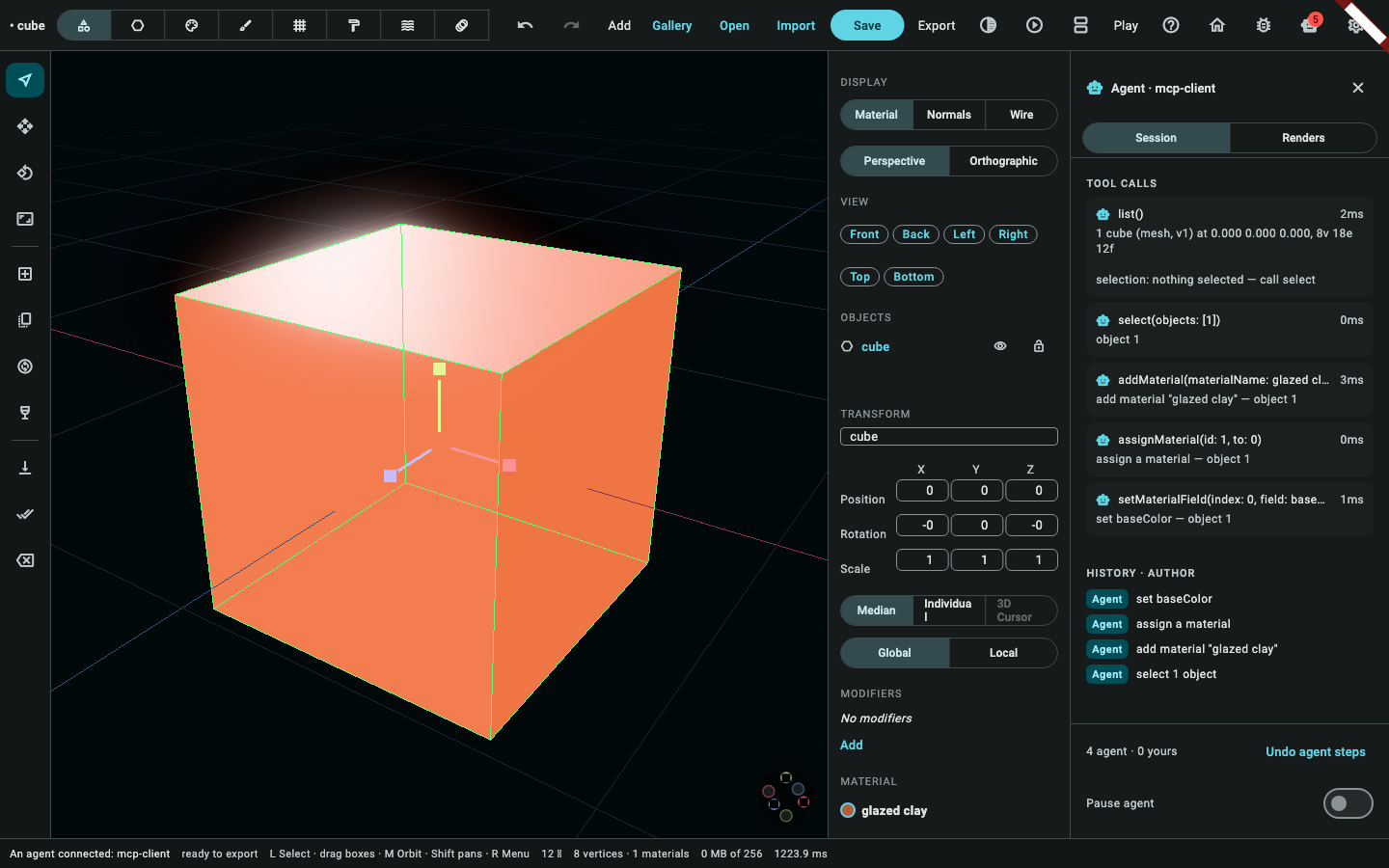
That picture is taken with a client genuinely on the other end: the test
that photographs it binds the port, reads mcp-session.json, and sends the
five requests below over a socket. The badge and the panel appear because a
client introduced itself, which is the only thing that makes them appear.
2. The agent does case 1's own five steps — over the tool surface
An agent connecting to that port sees the same tools
packages/flutter3d_model_mcp/test/tools_test.dart already tests directly:
list, rename, addMaterial, setMaterialField, assignMaterial, and
the rest. Case 1's own five steps, run again, but this time as an MCP client
actually would — a tool name plus a JSON object, not a typed Dart
constructor:
{"tool": "rename", "arguments": {"id": 1, "to": "teapot"}}
          {"tool": "addMaterial", "arguments": {"materialName": "glazed ceramic"}}
          {"tool": "setMaterialField", "arguments": {"index": 0, "field": "baseColor", "value": [0.92, 0.89, 0.82, 1.0]}}
          {"tool": "setMaterialField", "arguments": {"index": 0, "field": "metallic", "value": 0.0}}
Underneath, each call reaches modelCommandFromJson — the exact reader the
project file and the recovery journal both use — and then
session.run(command), recorded as StepAuthor.agent. The status line
reads the same after each call as it would after a person clicked the same
thing: list right after rename shows 1: "teapot" (mesh), and the
material count moves from 0 to 1 after addMaterial.
3. You, meanwhile, touch the same document
While the agent is mid-flow, you drag the roughness slider yourself, in the
same window, on the same object — say 0.35, a touch glossier than the
0.28 case 1 landed on. This lands on the identical ModelHistory the
agent's own tool calls are acting on (ModelerCubit.run calling
now.history.run(command) directly, no author named, which defaults to
StepAuthor.person) — not a merge, not a conflict dialog: one shared undo
stack, one step at a time, in whatever order the two of you actually work.
4. The agent finishes, and paints the teapot
{"tool": "assignMaterial", "arguments": {"id": 1, "to": 0}}
The history now reads, top to bottom: your own roughness edit, sitting
between the agent's setMaterialField(metallic) and its own
assignMaterial — five agent steps and one of yours, six in total, none of
them undone yet.
5. Undo, restricted to the agent's own steps
Ask the agent to undo. It calls the undo tool — the same one tools_test .dart exercises directly — which answers undid assign a material: its own
last step, taken back cleanly. Ask it to undo again, and it refuses, by
name:
the top step ("set roughness") is a person's own, not this session's — an
          agent does not undo someone else's work
Your own roughness edit is untouched — the refusal changes nothing. This is
ModelSession.undo's own real, working rule (mcp-10n), checked directly
rather than only asserted: it reads history.topStepAuthor before deciding,
and calls history.undo(onlyIfAuthoredBy: StepAuthor.agent), which itself
refuses (returns false, changes nothing) the moment the top step's author
does not match. Your own ⌘Z, on the other hand, is not gated the same
way — the app's own ModelerCubit calls ModelHistory.undo() with no
restriction at all, and it would reach straight past the agent's steps and
your own, taking back whichever step is on top regardless of whose it was.
One shared stack, two different doors into undo — an agent's is narrower
than yours, on purpose.
Below is this exact mixed-authorship project, rendered headlessly through
renderProject — case 1's own teapot, the agent's own base colour and
metallic, your own roughness:

Notes on this page
Time to complete: not recorded yet. TODO: a person should walk this
case by hand on a real machine and fill in a line here — "n minutes,
date, machine" — the way rel-09's own cohort rows do. Nothing in this
session could actually run the desktop app, so no time is claimed.
Screenshots. Taken headlessly rather than by hand —
apps/flutter3d_modeler/test/tutorial_case_screenshots_test.dart drives the
real editor under the software rasteriser and photographs the window — so
they are goldens: a run says whether a panel has moved since, and one
command regenerates every page's pictures at once.
(cd apps/flutter3d_modeler && flutter test \
            test/tutorial_screenshots_test.dart \
            test/tutorial_case_screenshots_test.dart --update-goldens)
          dart run tool/publish_modeler_screenshots.dart
This page's own picture needed a client on the other end of --mcp-port,
because ux-05 made the panel wait for a real initialize rather than for
an open port. The test stands one up: the editor is launched with the port
injected, and the requests go out over a raw socket rather than an
HttpClient, because the binding replaces that with a mock that answers
every request without touching the network.
The tool-call layer, and why the journal it writes looks the way it
does. Case 6's own fixtures (packages/flutter3d_model_mcp/test/fixtures/ tutorial/case6_scenario.dart) drive modelTools.firstWhere(...).run(session, arguments) for every agent step — a JSON map in, an Answer out — rather
than constructing a ModelCommand directly the way cases 1–5 do. Underneath,
model_tools.dart's own _command helper builds the exact same
ModelCommand through modelCommandFromJson and calls the exact same
session.run, so case6.jsonl is the same CommandJournal shape every
other case's .jsonl is — there is no second journal format here, only a
different door into writing the same one. The person's own roughness edit
runs directly against session.history instead, ModelerCubit.run's own
door in the real app — and used to be missing from the journal for
exactly that reason: ModelHistory.run recorded to nothing of its own,
only ModelSession.run/amend ever touched a CommandJournal, so a step
that came in through the other door was not refused and not recorded,
simply not there. This was tut-15 (doc/modeler-tutorial-gaps.md), a
quieter, more dangerous shape than case 2's own tut-05 (which at least
refused rather than succeeding on the wrong answer) — a cold replay
looked entirely successful and silently reached a project whose roughness
read SetMaterialField's own default (0.5), not the real 0.35.
Closed 2026-09-15, together with tut-05: ModelHistory itself now
carries an optional recovery journal that run/amend/every transaction
record to on every success, regardless of which door the caller came in
through — the person's own edit records under StepAuthor.person the same
way a step from ModelerCubit always has, an agent's own tool calls keep
recording under StepAuthor.agent through ModelSession.run as before,
and case6.jsonl now carries the roughness line in between them, in the
order it actually happened.
Undo restricted to the agent's own steps: real, and confirmed directly.
This is the one part of this case that is not a gap. ModelHistory.undo
takes an optional onlyIfAuthoredBy, ModelSession.undo calls it with
StepAuthor.agent and checks topStepAuthor first to give the clear
refusal sentence quoted above, and tutorial_scenarios_test.dart's own
case-6 group exercises exactly this: five agent tool calls around one direct
person edit, then the undo tool called twice — the first undoes the
agent's own last step, the second refuses by name, and the person's own
edit is confirmed untouched afterward. A final assertion in the same test
calls ModelHistory.undo() with no restriction — standing in for a
person's own ⌘Z in the real app — and confirms it reaches straight past the
same step the agent's own call had just refused. mcp-10n's own row is
closed; case 6 exists to show it working on a real, mixed-authorship
document rather than only asserting it in isolation.
Case 1's own import gap, re-checked and now closed. tut-01's own text
already flagged that case 6 would need to re-check whether an agent-driven
import needs ImportOptions sooner — it did, and the import tool now
takes them: unit, upAxis, and weld/fixNormals/triangulate, the
identical choice the app's own import screen offers a person. Case 6 still
starts from case1ImportedProject() (the same helper case 1's own fixture
uses, itself now built through ModelSession.import rather than around it)
rather than calling the import tool a second time here — this case is
about what an agent does to a document already open, not about repeating
case 1's own import step — so nothing on case6.jsonl or its fixtures
changes; only the tool's own reach did.
Proving it. packages/flutter3d_model_mcp/test/fixtures/tutorial/ case6_scenario.dart builds exactly the mixed-authorship project this page
describes, calling the real tool table for every agent step and
session.history.run directly for the one person step.
tutorial_scenarios_test.dart's own case-6 group checks three things: a
cold replay of case6.jsonl now reproduces the person's own edit too
(tut-15, closed — confirmed by reading back the real roughness, 0.35,
under StepAuthor.person, rather than the silent 0.5 default a build
before this fix landed on); building the scenario fresh over the real MCP
tool handlers reaches the exact project committed as case6.f3dproj and
exports the exact case6.glb, byte for byte; and the agent's own undo
tool refuses to reach past the person's own step while a raw,
unrestricted ModelHistory.undo() does not, confirming mcp-10n's own
mechanism directly on this case's own mixed history rather than only
trusting its unit tests elsewhere.